

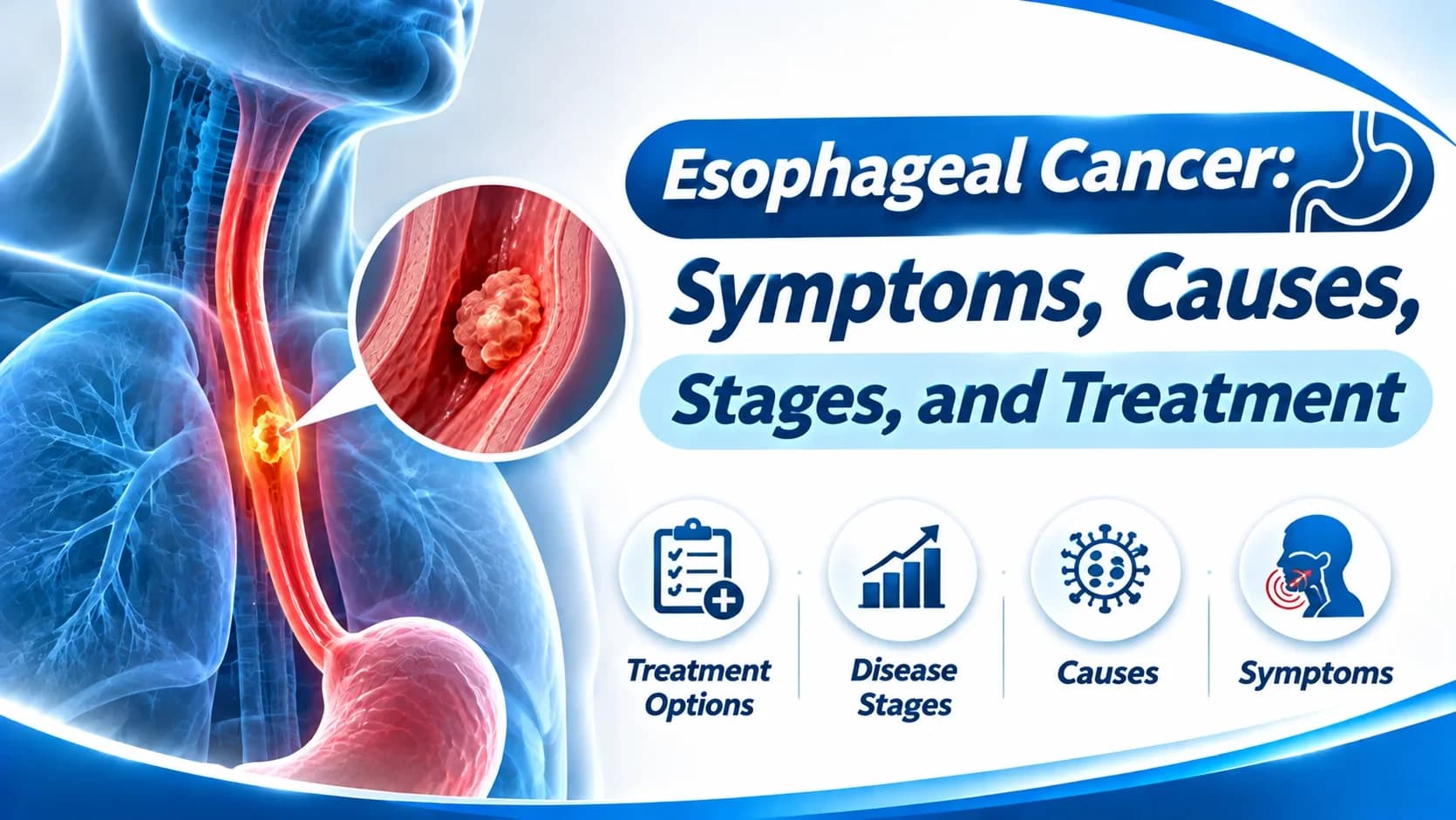
Some esophageal conditions may begin with mild symptoms that resemble common digestive disorders, such as heartburn or difficulty swallowing food. However, persistent or worsening symptoms require careful medical evaluation. Esophageal cancer is one of the conditions that requires particular attention because its symptoms may not be obvious in the early stages, while early detection can affect available treatment options and expected outcomes. In this article, we explore the types and causes of esophageal cancer, its early and advanced symptoms, how it is diagnosed, its stages of development, the latest treatment options, and the factors that influence the chances of recovery.
Medical Review Disclaimer: This article has been medically reviewed and approved by Dr. Alaa Mahfouz, Consultant and Lecturer of Surgical Oncology at the National Cancer Institute, Cairo University.
What Is Esophageal Cancer?
Esophageal cancer is the abnormal growth of cells lining the wall of the esophagus, the muscular tube that carries food and liquids from the throat to the stomach. The tumor usually begins in the inner lining of the esophagus and may gradually extend into deeper layers or spread to the lymph nodes and other organs in the body. Early diagnosis is important because some small, superficial tumors can be treated with limited procedures, while more advanced cases may require a combination of surgery and other treatments. Having digestive symptoms does not necessarily mean that a person has cancer, as more common benign conditions can cause similar symptoms.
What Are the Types of Esophageal Cancer?
There are different types of esophageal cancer, but the two most common are:
Squamous Cell Carcinoma
This type develops from the flat cells lining the inner surface of the esophagus. It can occur in the upper, middle, or lower part of the esophagus. The risk of developing this type is associated with factors such as smoking and alcohol consumption. Its prevalence also varies geographically between countries and regions.
Esophageal Adenocarcinoma
This type develops from the glandular cells that produce mucus. It most commonly occurs in the lower part of the esophagus, near the junction with the stomach. This type is associated with chronic gastroesophageal reflux disease (GERD) and Barrett's esophagus, a condition in which the cells lining the lower esophagus change due to repeated exposure to acid reflux.
Identifying the type of cancer through tissue examination is an essential step in selecting the appropriate treatment for each patient.
Early and Advanced Symptoms of Esophageal Cancer
Symptoms may not be obvious in the early stages of the disease, so symptoms alone cannot be relied upon to detect all early cases. As the tumor grows and narrows the inner passage of the esophagus, certain signs may begin to appear and progress.
Common Symptoms of Esophageal Cancer
Symptoms that may be associated with the disease include:
Difficulty swallowing, especially solid foods, which may eventually progress to include liquids.
A sensation that food is stuck in the throat or behind the breastbone.
Chest pain or discomfort, particularly when swallowing.
Unintentional weight loss without following a diet or changing lifestyle habits.
Persistent or worsening heartburn or indigestion.
Hoarseness or a chronic cough.
Vomiting after eating in some cases.
Fatigue and weakness, which may be associated with poor nutrition or bleeding.
Progressive difficulty swallowing is an important warning sign that requires medical evaluation, especially if it begins with solid foods and then progresses to soft foods and liquids.
Symptoms of Esophageal Cancer in Women
There is no separate set of symptoms specific to women; the main symptoms are similar in both sexes. They may include difficulty swallowing, chest pain, unexplained weight loss, persistent heartburn, coughing, or voice changes. Persistent symptoms should not be dismissed as a simple digestive disorder without examination, particularly when swallowing becomes increasingly difficult or unintentional weight loss occurs.
What Are the Causes and Risk Factors of Esophageal Cancer?
There is no single confirmed cause of all cases of esophageal cancer. However, certain factors increase the likelihood of developing the disease, and their effects vary depending on the type of tumor. The most important include:
Smoking and using tobacco products.
Alcohol consumption, which is particularly associated with squamous cell carcinoma.
Chronic gastroesophageal reflux disease (GERD), which is associated with adenocarcinoma.
Barrett's esophagus.
Overweight and obesity, particularly in relation to adenocarcinoma.
Older age.
Achalasia, a condition that affects the movement of food through the esophagus.
Repeatedly consuming very hot beverages.
Having one or more of these risk factors does not mean that a person will inevitably develop cancer. The disease can also occur in people who have no obvious risk factors.
How Is Esophageal Cancer Diagnosed?
Diagnosis relies on a combination of tests that help detect the tumor, determine its nature, and assess how far it has spread.
Esophageal Endoscopy and Biopsy
Upper gastrointestinal endoscopy is one of the most important diagnostic tests. It allows the doctor to examine the esophageal lining directly and identify any changes or abnormal areas. If a tumor is suspected, a tissue sample is taken and examined under a microscope. A biopsy is the primary method used to confirm the diagnosis and identify the type of cancer cells.
Tests to Determine the Stage of the Disease
After the diagnosis is confirmed, the doctor may request a CT scan or positron emission tomography (PET) scan, in addition to endoscopic ultrasound when appropriate. These tests help determine the depth of tumor invasion, the condition of the lymph nodes, and whether the disease has spread to other organs. The results are considered together to develop an appropriate treatment plan.
Stages of Esophageal Cancer
Esophageal cancer is classified into stages according to how deeply the tumor has grown and whether it has spread to the lymph nodes or distant organs:
Stage 0: Severe precancerous changes are present in the surface cells without deep invasion of the esophageal wall.
Stage I: The tumor is relatively limited to the esophageal wall.
Stage II: The tumor extends into deeper layers or reaches a limited number of nearby lymph nodes, depending on the classification.
Stage III: The disease is more advanced and may involve nearby tissues or a larger number of lymph nodes.
Stage IV: The cancer has spread to distant organs, such as the liver or lungs.
Determining the stage helps establish whether the tumor can be surgically removed and which treatment is most appropriate. Tumor size alone is not sufficient to determine the stage.
What Are the Treatment Options for Esophageal Cancer?
Treatment is determined according to the tumor type, location, stage, and the patient's general health. Care may require collaboration between surgical oncologists, medical oncologists, radiation oncologists, and other supporting specialists.
Treatment options include:
Surgery: To remove the affected part of the esophagus and, when necessary, nearby lymph nodes. It may be used for early-stage cases or as part of a multimodal treatment plan.
Chemotherapy: It may be given before or after surgery, or as part of the treatment plan for advanced cases.
Radiation therapy: It may be combined with chemotherapy before surgery or used in selected cases to control the tumor and relieve symptoms.
Targeted therapy and immunotherapy: These treatments may be used for certain patients based on the tumor's characteristics and the results of molecular and immune testing.
Endoscopic treatment: It may be suitable for some early-stage, superficial tumors that have not invaded the deeper layers.
A diagnosis of esophageal cancer does not necessarily mean that surgery is required in every case. The treatment decision is made after a comprehensive evaluation.
Esophageal Cancer Survival Rate: Is the Disease Serious?
Esophageal cancer is a serious type of cancer, particularly when it is diagnosed after spreading. However, the chances of controlling and treating the disease vary significantly depending on the stage at diagnosis, tumor type, whether it can be surgically removed, and the patient's response to treatment.
According to the American Cancer Society, based on data from patients diagnosed between 2015 and 2021 in the United States, the five-year relative survival rates were approximately 49% for localized cases, 28% for cases that had spread to nearby areas, and 5% for cases that had spread to distant organs.
These figures do not represent an individual's chance of being cured and cannot be directly applied to all patients or considered a prediction for a specific case. Age, general health, tumor type and characteristics, and response to treatment all influence medical outcomes.
Book a Consultation for Esophageal Tumor Evaluation
If you experience persistent difficulty swallowing, unexplained weight loss, or concerning digestive symptoms, do not delay medical evaluation. A specialist examination helps identify the cause of the symptoms and determine the necessary tests, whether the condition is benign or related to a tumor that requires treatment.
You can contact Dr. Alaa Mahfouz, Consultant and Lecturer of Surgical Oncology at the National Cancer Institute, Cairo University, to book a consultation, have your condition evaluated, and develop an appropriate treatment plan based on the test results.
Frequently Asked Questions About Esophageal Cancer
Do Symptoms of Esophageal Cancer Appear in the Early Stages?
Symptoms may not be obvious in the early stages. When they do appear, they may include difficulty swallowing or pain when swallowing. Therefore, persistent difficulty swallowing requires prompt medical evaluation.
Are the Symptoms of Esophageal Cancer Different in Women and Men?
The main symptoms are similar in women and men. They include difficulty swallowing, weight loss, chest pain, persistent heartburn, coughing, or hoarseness.
Can an Esophageal Tumor Be Benign?
Yes. Benign tumors can develop in the esophagus, such as certain leiomyomas, but they are not cancerous. Endoscopy and biopsy, when necessary, help determine the nature of the tumor. It is not possible to distinguish between benign and malignant tumors based on symptoms alone.
What Does Esophageal Cancer Look Like During Endoscopy?
It may appear as an abnormal area, a raised mass, an ulcer, or a narrowing of the esophageal lumen. However, appearance alone cannot confirm cancer. A tissue sample must be examined to determine the nature of the abnormality.
Is Esophageal Cancer a Serious Disease?
Yes, it can be serious, particularly when diagnosed at an advanced stage. However, several treatment options are available, and the chances of successful treatment are generally better when the disease is detected early.
Can Stage 4 Esophageal Cancer Be Cured?
Stage 4 is more difficult to treat, and in many cases, the goal is to control the disease, prolong life, and improve quality of life. Chemotherapy, immunotherapy, and targeted therapy may help some patients achieve a response. This depends on the tumor's characteristics and the patient's general health.
