

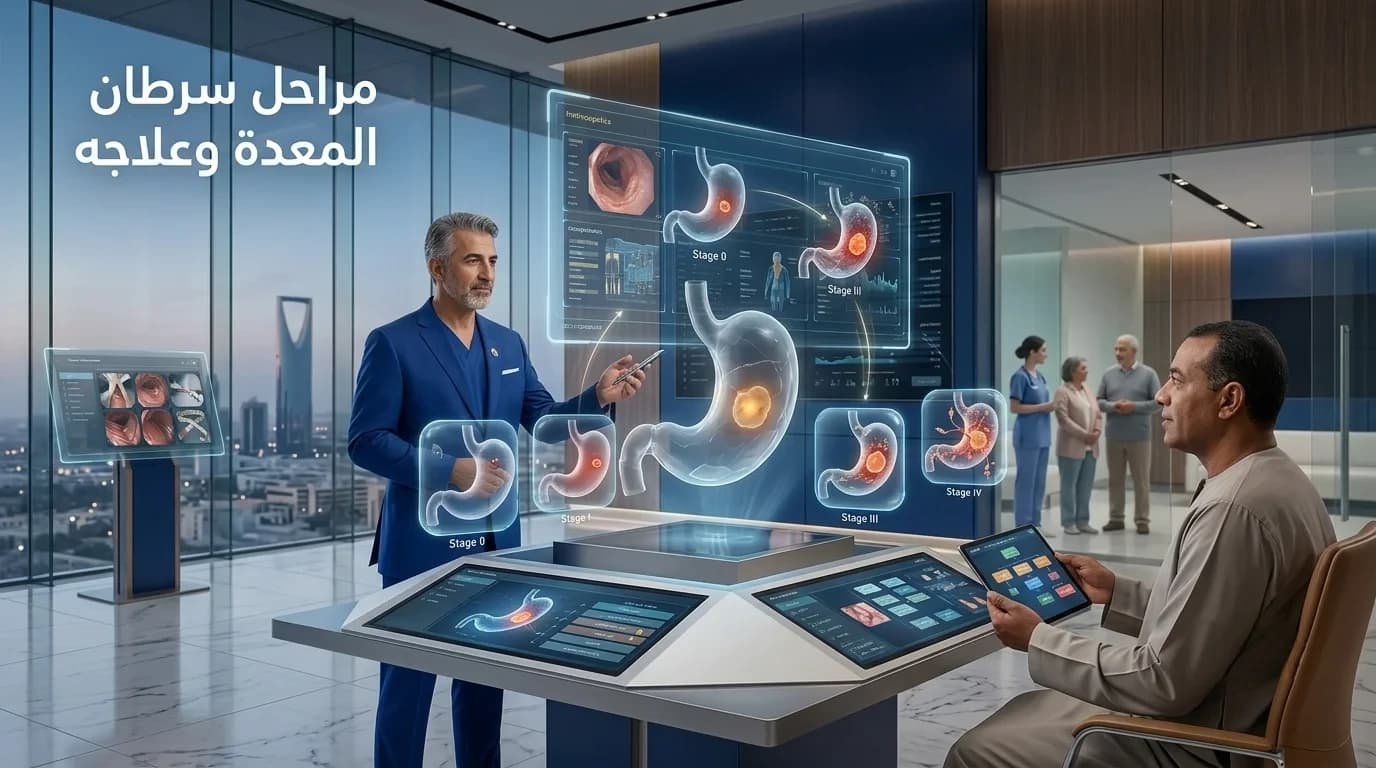
Cancer staging is one of the main factors doctors rely on to assess how far the disease has spread and develop an appropriate treatment plan for each patient. Treatment options and the chances of recovery vary depending on the stage. Understanding how stomach cancer progresses from Stage 1 to Stage 4 can also help patients make informed medical decisions.
This comprehensive guide explains the stages of stomach cancer, how each stage is determined, the main symptoms associated with the disease, and important recommendations for early detection and reducing the risk of complications.
What Is Stomach Cancer and How Does It Develop?
Stomach cancer is a type of cancer that develops when cells in the stomach lining begin to grow abnormally and uncontrollably, potentially forming a tumor that may increase in size over time. In its early stages, the tumor usually remains limited to the inner layers of the stomach.
However, if the disease is not detected and treated early, it may extend into deeper layers of the stomach wall and eventually spread to nearby lymph nodes and organs. This progression is what distinguishes the different stages of stomach cancer and influences the choice of treatment. Most cases of stomach cancer develop gradually over several years, depending on various risk factors.
How Are the Stages of Stomach Cancer Determined?
Stomach cancer staging is not based on symptoms alone. Doctors use several diagnostic methods to determine the stage, including:
Upper gastrointestinal endoscopy to confirm the diagnosis and examine cancerous cells.
Endoscopic ultrasound to determine how deeply the tumor has invaded the stomach wall.
CT scans to assess the size of the tumor and whether it has spread.
MRI scans in certain cases to detect cancer spread.
Laboratory tests to evaluate the patient's overall health and organ function.
The international TNM staging system to determine the final stage based on tumor size, lymph node involvement, and distant spread.
Stages of Stomach Cancer
Stomach cancer is generally classified into four main stages based on the size of the tumor and how far it has spread within the stomach, to nearby lymph nodes, or to other organs. This classification helps doctors determine the most appropriate treatment and assess the patient's condition accurately. Below is an overview of each stage, including its main characteristics and available treatment options.
Stage 1 Stomach Cancer
Stage 1 stomach cancer is considered an early stage. The tumor remains limited to the stomach lining without spreading to distant organs, which means treatment outcomes are generally more favorable when the disease is diagnosed early. This stage is characterized by:
The tumor is relatively small and confined to the stomach.
Symptoms may be absent or mild and can include indigestion and loss of appetite.
The cancer has not spread to distant organs.
The chances of successful treatment are generally higher when the disease is diagnosed early.
Stage 2 Stomach Cancer
Stage 2 stomach cancer is characterized by increased tumor growth compared with Stage 1. The tumor may extend into deeper layers of the stomach wall and involve a greater number of nearby lymph nodes, while there is no distant spread to other organs. Key characteristics include:
The tumor extends into deeper layers of the stomach wall.
It may spread to some nearby lymph nodes.
The cancer has not spread to distant organs such as the liver or lungs.
Accurate assessment of the extent of the tumor is necessary to determine the appropriate treatment plan.
Stage 3 Stomach Cancer
Stage 3 is considered an advanced stage in which the tumor has spread deeper into the stomach wall and reached a larger number of nearby lymph nodes, but it has not yet spread to distant organs. This stage may include:
The disease extends through most layers of the stomach wall.
It spreads to a greater number of nearby lymph nodes.
Symptoms may become more noticeable, including weight loss, difficulty eating, and stomach pain.
Careful evaluation is required to determine the extent of the tumor and develop an appropriate treatment plan.
Stage 4 Stomach Cancer
Stage 4 is the most advanced stage, in which the cancer has spread beyond the stomach to distant organs or other tissues in the body. Accurately assessing the extent of the spread is essential for determining the most appropriate approach to managing the condition. This stage may involve:
Spread of the tumor to distant organs such as the lungs, liver, or peritoneum.
Involvement of nearby and distant lymph nodes may occur.
Careful follow-up and evaluation are required to assess the extent of cancer spread and develop an appropriate treatment plan.
Symptoms of Stomach Cancer According to Stage
Symptoms of stomach cancer vary depending on the stage of the disease. They may be mild and difficult to notice during the early stages, while becoming more apparent as the tumor progresses and spreads. The presence of a single symptom does not necessarily indicate stomach cancer, but persistent or recurring symptoms should be evaluated by a doctor. Symptoms may include:
Frequent indigestion or heartburn.
Loss of appetite or feeling full after eating a small amount of food.
Pain in the upper abdomen.
Nausea accompanied by general fatigue.
Difficulty swallowing if the tumor is located near the upper part of the stomach.
Dark stools or signs of gastrointestinal bleeding in some cases.
Stomach Cancer Treatment According to Each Stage
Treatment for stomach cancer depends on the stage, size, and extent of tumor spread. The main treatment options according to each stage include:
Stage 1
Surgery is usually the primary treatment option for removing the tumor. Additional treatments may be recommended in some cases depending on the pathology results.
Stages 2 and 3
Treatment often involves a combination of approaches, such as surgery and chemotherapy, with the goal of reducing the tumor size and lowering the risk of recurrence.
Stage 4
Treatment focuses on controlling cancer spread, relieving symptoms, and improving the patient's quality of life. It may include chemotherapy or immunotherapy depending on the nature and characteristics of the disease.
Tips for Prevention and Early Detection
It is not possible to prevent all cases of stomach cancer. However, following a healthy lifestyle and paying attention to early detection can help reduce the risk and increase the likelihood of identifying the disease at an earlier stage. We recommend the following measures:
Follow a balanced diet rich in fresh vegetables and fruits.
Avoid alcohol and quit smoking.
Treat H. pylori infection when diagnosed according to the doctor's recommendations.
Limit the consumption of smoked, salted, and processed foods.
When Should You See a Doctor?
If symptoms such as recurring stomach pain, unexplained weight loss, difficulty swallowing, or feeling full after eating small amounts of food persist, it is important not to delay consulting a doctor, especially if these symptoms continue for several weeks or become more severe. Early diagnosis can help detect the disease at an earlier stage, which may improve treatment outcomes.
Dr. Alaa Mahfouz, Consultant and Lecturer of Surgical Oncology at the National Cancer Institute, Cairo University, provides accurate medical evaluation using advanced diagnostic methods and develops individualized treatment plans based on each patient's condition and current medical standards.
Conclusion
Understanding the stages of stomach cancer is an important step in determining how far the disease has spread and selecting the most appropriate treatment plan. Early detection can significantly improve treatment outcomes and help reduce the risk of complications.
Frequently Asked Questions About Stomach Cancer Stages
Can Stomach Cancer Be Cured?
Yes. The chances of successful treatment are generally higher when stomach cancer is detected at an early stage and appropriate treatment is started. In advanced stages, outcomes vary depending on how far the tumor has spread and how well the patient responds to treatment.
What Is the Most Dangerous Stage of Stomach Cancer?
Stage 4 is the most advanced stage of stomach cancer because it indicates that the cancer has spread to distant organs in the body. Treatment can therefore be more complex compared with earlier stages.
Do Stomach Cancer Symptoms Differ from One Stage to Another?
Yes. Symptoms may be mild or unclear during the early stages and become more noticeable as the disease progresses. These may include weight loss, persistent stomach pain, difficulty eating, and general fatigue.
