

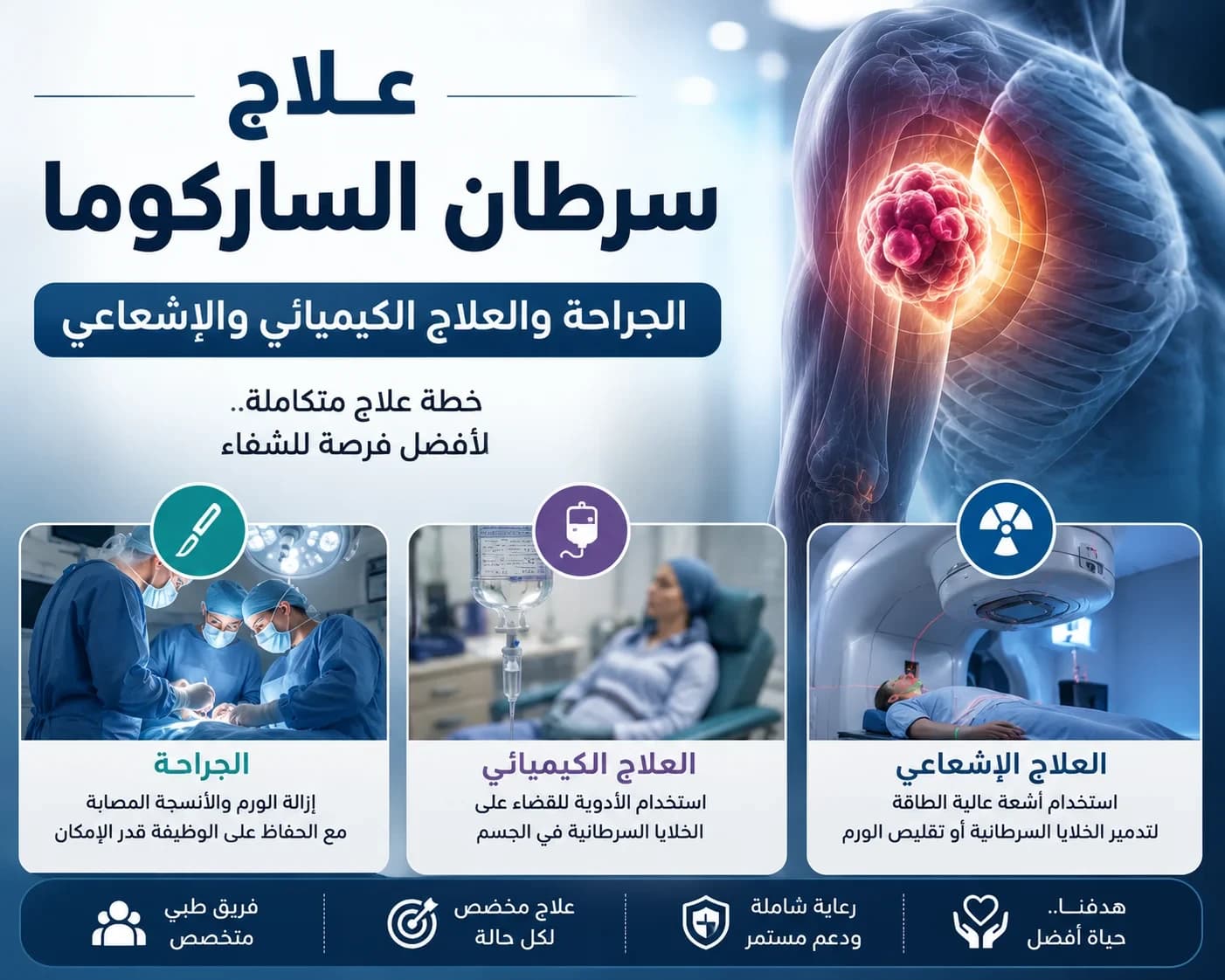
Sarcoma cancer treatment requires careful evaluation because sarcoma includes a group of different tumors that may affect the bones or soft tissues. The treatment approach varies depending on the type, location, size, stage, and extent of the tumor. The treatment plan may include surgery, chemotherapy, radiation therapy, or a combination of more than one treatment method according to the nature of each case.
In this article, we discuss the main treatment options for sarcoma, when surgery may be appropriate, the role of chemotherapy and radiation therapy, how the treatment of bone sarcoma differs from soft tissue sarcoma, as well as the most important factors that influence treatment selection and outcomes.
This article was medically reviewed by Dr. Alaa Mahfouz – Consultant and Lecturer of Surgical Oncology.
What Is Sarcoma Cancer Treatment and How Does the Doctor Determine the Treatment Plan?
There is no single treatment method that is suitable for all cases of sarcoma because the term includes multiple types of tumors that may affect the bones or soft tissues. Therefore, determining the treatment begins with confirming the diagnosis and identifying the type and characteristics of the tumor, followed by assessing its spread, location, size, and growth rate. The treatment plan may rely on one treatment method or combine several approaches, such as surgery, radiation therapy, and drug therapy.
What Factors Does the Doctor Consider When Choosing the Treatment?
The treatment plan is selected based on several factors, including:
Type of sarcoma: The response to treatment varies from one type to another.
Tumor location: Its location and relationship with the surrounding organs, nerves, or blood vessels affect whether it can be removed and how treatment is performed.
Tumor size and grade: These factors help estimate the tumor's behavior and likelihood of spreading.
Disease stage: Whether the tumor is localized or has spread to the lymph nodes or other parts of the body.
Possibility of completely removing the tumor: This is an important consideration when planning surgery.
Patient's overall health: Including age and the ability to tolerate different types of treatment.
Previous treatment or recurrence: Recurrent sarcoma may require a different strategy from a case being treated for the first time.
Why Does Sarcoma Treatment Require Careful Planning?
In sarcoma cases, it may be important to have the condition evaluated by a specialized sarcoma treatment team because treatment decisions may require coordination between a surgical oncologist, medical oncologists, radiation oncologists, radiologists, and pathologists. This evaluation aims to determine the most appropriate sequence of treatments for each case, such as performing surgery first or using treatment before or after surgery when needed.
Therefore, the appropriate sarcoma cancer treatment cannot be determined based on the name of the disease alone. The treatment plan must be developed after reviewing the diagnosis, medical tests, biopsy results, imaging, and the patient's condition as a whole.
Sarcoma Surgery: When Is It the Main Treatment Option?
Surgery is one of the most important treatment methods for many cases of sarcoma, especially when the tumor is localized and can be completely removed. The primary goal is to remove the tumor with an appropriate margin of surrounding tissue while preserving the function of the affected organ or limb as much as possible. The decision to perform surgery depends on the type, location, size, and grade of the sarcoma and the extent to which it has spread to nearby tissues.
When Is Surgery the Main Treatment Option?
Surgery is one of the main treatment options when medical tests and evaluation indicate that the tumor can be completely removed with an acceptable level of risk. Surgery may be an essential part of the treatment plan in cases such as:
Localized resectable sarcoma: When the tumor has not spread to distant sites and can be safely removed.
Small low-grade tumors: Surgery alone may be sufficient in selected cases, especially when clear surgical margins can be achieved.
Tumors located in the limbs: Limb-sparing surgery may be possible instead of amputation when the tumor can be removed while preserving an adequate level of limb function.
Some advanced or recurrent cases: Surgery may still be an appropriate option if the tumor or specific areas of spread can be removed. This is determined through a comprehensive evaluation of the case.
What Does Resection With Clear Margins Mean?
The surgical goal is not limited to removing the visible part of the tumor. The surgeon aims to remove the tumor along with an appropriate amount of surrounding tissue according to the tumor's nature and location. After surgery, a pathologist examines the specimen to assess the surgical margins. If no cancer cells are found at the edges, the margins are described as clear or negative. Positive margins may indicate the presence of tumor cells at the edge and the possible need for additional treatment evaluation.
Does Surgery Require Additional Treatment?
Surgery is not necessarily the only treatment. In some cases, radiation therapy or chemotherapy may be used before or after surgery, depending on the type of sarcoma, its risk level, location, and the possibility of achieving complete resection. Treatment may be used before surgery in selected cases to help reduce the tumor size or improve its resectability, while treatment after surgery may be used to reduce the risk of recurrence in some cases.
Therefore, determining whether surgery is the main treatment option and whether additional treatment is required should be based on a comprehensive evaluation by a specialized sarcoma treatment team rather than on the tumor size or location alone.
Does Sarcoma Require Chemotherapy?
Not all sarcoma cases require chemotherapy. The decision to use chemotherapy depends on the type of sarcoma, its stage and grade, size, location, extent of spread, and whether it can be surgically removed. In some localized sarcoma cases, surgery may be the primary treatment, while chemotherapy may be considered for higher-risk or advanced cases or as part of a treatment plan that combines more than one approach.
When Can Chemotherapy Be Used for Sarcoma?
Chemotherapy may be included in the treatment plan in several situations, including:
Before surgery: In selected cases, with the aim of reducing the tumor size or helping make it more suitable for surgical removal.
After surgery: It may be considered in some high-risk cases, although its benefit in localized soft tissue sarcoma has not been established uniformly for all patients.
When the disease has spread: Chemotherapy may be used as systemic treatment when sarcoma is advanced or metastatic. The choice of medication depends on the type of sarcoma and the characteristics of the case.
In some types of sarcoma that are more responsive to chemotherapy: Tumors differ in their sensitivity to treatment, so the same protocol cannot be applied to all sarcoma patients.
Do All Types of Sarcoma Respond to Chemotherapy in the Same Way?
No. Sarcoma is not a single type of cancer. There are many subtypes that differ in their nature and response to treatment. Therefore, chemotherapy may be more important for certain types or stages than others, and different medications or treatment approaches may be used based on the histological type of the tumor.
For this reason, chemotherapy should not be started simply because sarcoma has been diagnosed. The type of sarcoma must first be accurately identified, followed by an assessment of the disease stage and the patient's overall condition. The expected benefits of treatment and its potential side effects can then be discussed as part of a treatment plan developed by a specialized sarcoma treatment team.
Treatment of Metastatic and Recurrent Sarcoma: What Options Are Available?
Metastatic or recurrent sarcoma requires a comprehensive reassessment before determining a new treatment plan because treatment depends on the type of sarcoma, the location of recurrence or spread, the number of lesions, whether they can be surgically removed, and the treatments the patient has previously received. Therefore, there is no single treatment plan that is suitable for all cases. Treatment may combine local interventions with systemic therapies.
What Treatment Options Are Available for Recurrent or Metastatic Sarcoma?
The treatment plan may include one or more of the following options:
Surgery: It may be considered when recurrent disease can be removed or in some cases where the spread is limited and the affected lesions can be removed, such as certain cases of sarcoma that has spread to the lungs.
Chemotherapy: It may be used when sarcoma cannot be surgically removed or has spread. The choice of drug or combination of drugs depends on the type of sarcoma, previous treatments, and the patient's overall health.
Targeted therapy: Certain targeted drugs may be used for specific types of soft tissue sarcoma. Their selection depends on the subtype and molecular characteristics of the tumor.
Immunotherapy: It may be appropriate for certain types of sarcoma or as part of clinical trials. It is not a general treatment for all cases.
Radiation therapy: It may be used to control certain recurrent tumors or lesions that cannot be surgically removed, or to relieve some symptoms depending on the location of the disease.
Clinical trials: These may be an important option for some patients, particularly when the disease has returned or does not respond to available treatments, as they provide access to new treatments or treatment combinations under evaluation.
Can Sarcoma Surgery Be Performed After It Has Spread?
Yes. Metastatic disease does not automatically mean that surgery is impossible. In selected cases, particularly when the number of lesions is limited and they can be completely removed, surgery may be part of the treatment plan. The decision depends on the location and number of metastatic lesions, the possibility of removing them, the patient's overall health, and previous treatments.
If the disease is widely metastatic or cannot be removed surgically, the focus may be on systemic treatment and controlling the disease and its symptoms, with treatment selected according to the type and characteristics of the sarcoma.
Therefore, recurrent or metastatic sarcoma requires evaluation by a specialized sarcoma treatment and surgical oncology team to determine whether the goal should be to remove the disease, control it, or combine more than one treatment approach.
What Factors Affect the Success of Sarcoma Cancer Treatment?
The chances of successful sarcoma treatment cannot be determined based on a single factor or the name of the disease alone because outcomes vary according to the type and characteristics of the tumor, the stage at which it is detected, and its response to treatment. Therefore, evaluating the condition depends on several pieces of information obtained through medical tests, imaging, and tissue analysis, which are then used to determine the most appropriate treatment and estimate the chances of controlling the disease.
The Most Important Factors Affecting Sarcoma Treatment Outcomes
Type of sarcoma: The nature of the tumor and its response to treatment vary according to the sarcoma subtype.
Tumor size: Larger tumors tend to be associated with less favorable outcomes than smaller tumors, although this varies according to the type of sarcoma.
Tumor grade: Tumor grade indicates how different the cancer cells are from normal cells and how quickly the tumor may grow and spread. Higher grades are generally associated with more aggressive behavior.
Disease stage: A tumor that remains at its original site differs in terms of treatment outlook from cases where it has spread to the lymph nodes or distant organs.
Tumor location and depth: The location of the sarcoma and its relationship with surrounding tissues and organs can affect whether it can be removed and influence the treatment plan.
Possibility of completely removing the tumor: Achieving complete resection with clear surgical margins is an important factor in controlling localized disease and reducing the likelihood of recurrence.
Presence of metastasis or recurrence: Metastatic or recurrent sarcoma requires a different evaluation from cases diagnosed while the disease is localized.
Patient's overall health: Age, general health, and ability to tolerate treatment are factors considered when selecting the treatment plan and evaluating its outcomes.
Does Early Detection of Sarcoma Affect Treatment Outcomes?
In general, detecting sarcoma while it is localized and treatable is an important factor in treatment outcomes, while treatment may become more complex when the tumor is large, high-grade, or has spread to other areas. However, the stage alone cannot be used to predict what will happen to an individual patient because the type of sarcoma, its location, tumor grade, and response to treatment all contribute to the overall assessment.
Therefore, it is more accurate to discuss the factors that affect treatment outcomes rather than provide a single success rate for all sarcoma patients because each case has its own characteristics and treatment plan.
When Should You Consult a Surgical Oncologist Specializing in Sarcoma Treatment?
If you have been diagnosed with sarcoma or have a mass that requires careful evaluation, consulting a surgical oncologist who specializes in tumors can help you understand the nature of the condition and determine the appropriate treatment steps based on medical tests, imaging, and laboratory results. Because sarcoma types and treatment approaches vary, some cases may require specialized surgery or a combination of surgery with other treatments as part of a comprehensive plan.
If you are looking for a specialized evaluation for sarcoma or a medical opinion regarding the possibility of surgery and the appropriate treatment plan, you can contact Dr. Alaa Mahfouz, Consultant and Lecturer of Surgical Oncology at the National Cancer Institute – Cairo University, to schedule an appointment and discuss your condition based on your medical tests and reports.
Frequently Asked Questions
Does Every Case of Sarcoma Require Surgery?
No. The need for surgery varies depending on the type of sarcoma, tumor location, size, stage, and whether it can be surgically removed. In some cases, surgery may be the primary treatment, while other cases may require surgery combined with chemotherapy or radiation therapy.
Can Sarcoma Be Treated Without Surgery?
In some cases, other treatments may be used instead of surgery or alongside it. This depends on the type of sarcoma, disease stage, and tumor location. Therefore, the appropriate treatment cannot be determined without a comprehensive medical evaluation.
Is Chemotherapy Suitable for All Types of Sarcoma?
No. Sarcoma's response to chemotherapy varies according to the tumor subtype and disease stage. Chemotherapy may be used before or after surgery or in cases of metastatic disease according to the appropriate treatment plan.
